
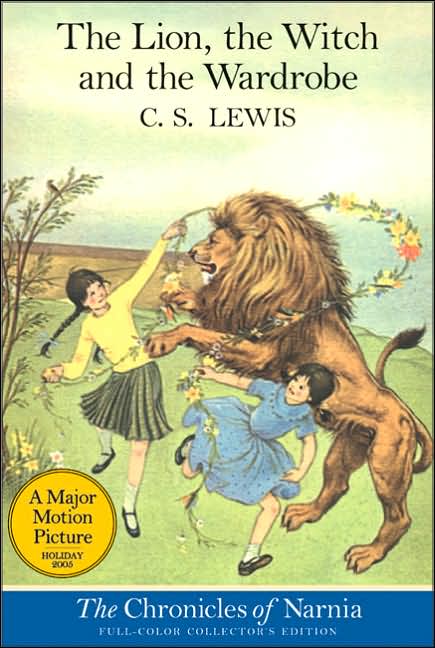
 Series: The Chronicles of Narnia [#2]
Title: The Lion, the Witch, and the Wardrobe
Pages: 206
Rating: 5/5
Synopsis: In the midst of World War II, the Pevensie children are sent to Professor Digory Kirke’s house. While there they discover a magical wardrobe that transports them to the magical land of Narnia. Under the dictatorship of the White Witch, Narnia is frozen in eternal winter. It is up to the Pevensies to save Narnia and usher in the return of Aslan, the true king. But when one of the Pevensies turns traitor, will Narnia be doomed forever?
Personal Review: I’ve written before about my personal connection with and deep love for Narnia, so I’m going to try to keep this as unbiased as possible. Kind of.
Unfortunately, The Chronicles of Narnia has suffered abuse at the hands of some literary critics and other readers for being “too childish,” “too religious,” and, essentially, “dumb.” Even J.R.R. Tolkien, Lewis’ best friend, had doubts that this book would sell. I know one person who began telling me how idiotic the series was, then ended with a confession of not having ever read the series and never wanting to because it “sounded ridiculous.” Rule number one of book bashing: don’t trash it until you’ve read it. The only reason I feel perfectly fine pointing out how awful Harry Potter is to people is because I’ve read all seven books.
Anyway, I digress. No, The Chronicles of Narnia isn’t a literary masterpiece on the plane as, say, The Odyssey. It’s a very simple read and quite easy to understand. To be honest, the first time I read The Lion, the Witch, and the Wardrobe I completely missed the Christian themes. Sure, they’re there, but at the end of the day it’s just a good fantasy story. Even if you’re not religious it’s pretty easy to ignore them.
What makes this such a classic and a staple in fantasy literature? For one thing, it has all the enjoyable elements of fantasy: talking animals, magic, fantasy creatures, good vs. evil, adventure, and prophecies.
I think the most important element, though, are the characters. For me, Edmund is the most relatable. He gets the most crap from everyone and it upsets me to no end. It’s gotten to the point I can’t even talk to my family about Edmund because all they ever talk about how much of a brat he is and completely overlook his redemption.
I first read Narnia when I was 14 going on 15. During that time I was suffering from depression and was constantly angry. Quiet honestly, I felt like a monster because I just seemed to upset people around me. I felt like Edmund – mean and nasty. I didn’t feel any hope for being able to change. I paralleled Edmund’s journey with mine. In the end, Edmund was forgiven. Heck, HE was the one who destroyed the White Witch’s wand! He became known as King Edmund The Just. Edmund is a symbol of all of us and how, no matter how far we’ve gone, there’s always hope. We can mend our ways and change, and most importantly, move on.
I have a Lucy streak in me – a wild imagination and curiosity. I have a Susan streak in me – I’ve a logical thinker. I’m not sure if I have a Peter streak in me, but hopefully one day I’ll be a great leader like him.
Lewis has a perfect balance of giving description, but not giving too much that it impedes on your imagination. He’s very good at getting emotions across, like when he describes how the Pevensies felt when Mr. Beaver told them about Aslan in his home.
It’s actually been quite a few years since I’ve read this book all the way through. I still got a little emotional when I read about the coronation scene.
You’re entitled to not like The Chronicles of Narnia. I’ll probably think you’re stark mad, but your opinion is yours. However, I do think you’re doing yourself a disservice by not reading this book at all. Even if you read just one book from this series, make it The Lion, the Witch, and the Wardrobe. C.S. Lewis is a genius and a master at his craft.
This is childhood in 206 pages. It’s hope. It’s love. It’s forgiveness.
It will forever be a part of who I am.


 kimonalimb.com
Leave a reply to Zinah Cancel reply